Fink's Taxonomy of Significant Learning
Designing Learning That Lasts
While traditional taxonomies focus primarily on what students know, Fink's Taxonomy of Significant Learning expands course design to include the knowledge, skills, values, and experiences that create meaningful, lasting learning.
Rather than viewing learning as a hierarchy, Fink's six dimensions are interconnected. Growth in one area strengthens learning in the others, creating richer educational experiences.
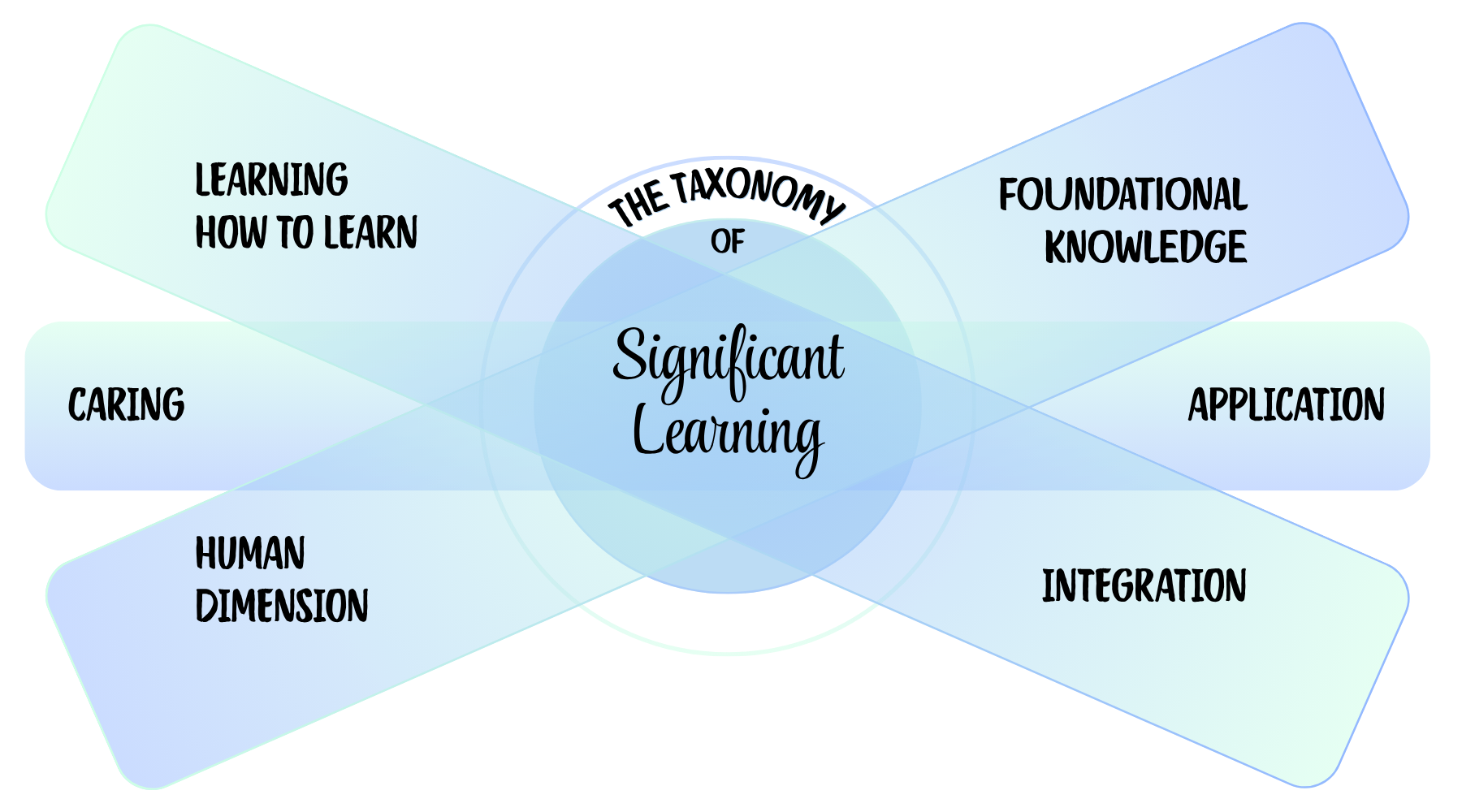
The Six Dimensions of Significant Learning
- Foundational Knowledge
Students acquire the essential concepts, facts, theories, vocabulary, and principles needed to understand a discipline. This knowledge provides the foundation for deeper learning.
Faculty Applications
- Introduce key concepts
- Build prerequisite knowledge
- Use readings, lectures, videos, and demonstrations
- Check understanding with low-stakes assessments
Example Activities
- Reading quizzes
- Interactive lectures
- Flashcards
- Concept maps
- Knowledge checks
Sample Learning Outcome
Students will explain the major theories of organizational leadership.
Action Verbs
Define • Describe • Identify • Explain • Recall • Recognize • List • Summarize • Label • State
- Application
Students use knowledge to solve problems, make decisions, evaluate information, practice
skills, and think critically.
Application includes
- Critical thinking
- Creative thinking
- Practical skills
- Project management
Faculty Applications
- Case studies
- Simulations
- Labs
- Data analysis
- Problem-solving activities
Example Activities
- Solve authentic problems
- Analyze scenarios
- Complete laboratory exercises
- Design prototypes
- Conduct research
Sample Learning Outcome
Students will apply statistical techniques to analyze research data.
Action Verbs
Apply • Analyze • Solve • Demonstrate • Calculate • Design • Develop • Evaluate • Interpret • Create • Test • Compare
- Integration
Students connect ideas across disciplines, experiences, perspectives, or real-world situations. Learning becomes more meaningful when students recognize relationships between concepts.
Faculty Applications
- Interdisciplinary projects
- Community-based learning
- Cross-course assignments
- Collaborative learning
Example Activities
- Connect theory to practice
- Compare multiple viewpoints
- Integrate research from different disciplines
- Relate classroom learning to professional experiences
Sample Learning Outcome
Students will connect psychological theories with workplace leadership practices.
Action Verbs
Connect • Integrate • Relate • Compare • Contrast • Synthesize • Combine • Associate • Link • Correlate
- Human Dimension
Students learn about themselves and understand how to work effectively with others. This
dimension develops interpersonal and intrapersonal awareness.
Faculty Applications
- Group projects
- Peer feedback
- Leadership experiences
- Self-assessments
- Team-based learning
Example Activities
- Reflection journals
- Team presentations
- Peer evaluations
- Leadership roles
- Professional identity assignments
Sample Learning Outcome
Students will evaluate their strengths and challenges when working in collaborative teams.
Action Verbs
Reflect • Collaborate • Lead • Communicate • Evaluate • Demonstrate • Participate • Advocate • Support • Mentor
- Caring
Students develop new interests, values, motivations, or appreciation for the subject and its importance. Learning becomes personally meaningful and motivates continued engagement.
Faculty Applications
- Service-learning
- Community engagement
- Ethical discussions
- Real-world case studies
- Personal reflection
Example Activities
- Ethical debates
- Community projects
- Personal learning reflections
- Career exploration
- Guest speakers
Sample Learning Outcome
Students will value the importance of ethical decision-making in professional practice.
Action Verbs
Value • Appreciate • Support • Respect • Advocate • Commit • Choose • Engage • Promote • Defend
- Learning How to Learn
Students become self-directed learners who can continue learning beyond the course. This dimension emphasizes lifelong learning, reflection, metacognition, and information literacy.
Faculty Applications
- Research projects
- Learning portfolios
- Self-reflection
- Goal setting
- Information literacy instruction
Example Activities
- Reflective journals
- Learning portfolios
- Research planning
- Self-assessments
- Professional development plans
Sample Learning Outcome
Students will evaluate their learning strategies and develop a plan for continued professional growth.
Action Verbs
Reflect • Assess • Plan • Monitor • Investigate • Research • Revise • Improve • Evaluate • Explore • Adapt
Using Fink's Taxonomy in Course Design
When designing a course, consider how each learning experience supports multiple dimensions of significant learning.
For example, a capstone project may:
- Build Foundational Knowledge by applying core concepts.
- Develop Application through authentic problem-solving.
- Encourage Integration by connecting ideas across disciplines.
- Strengthen the Human Dimension through teamwork and communication.
- Foster Caring by addressing real-world challenges.
- Promote Learning How to Learn through reflection and self-assessment.
Designing activities that address multiple dimensions helps create engaging, meaningful, and lasting learning experiences.
Best Practices
- Design learning activities that support more than one dimension.
- Include opportunities for reflection throughout the course.
- Connect learning to authentic, real-world contexts.
- Encourage collaboration and peer learning.
- Use formative assessments to provide timely feedback.
- Incorporate self-assessment and metacognitive activities.
- Align assignments, assessments, and learning outcomes to promote significant learning experiences.
By intentionally designing for all six dimensions, faculty can create courses that not only develop knowledge and skills but also inspire curiosity, confidence, and lifelong learning.